

Publications
Kyung-Joong Kim and Tae-Kyung Yoo. (2026). Integrated Pipeline for Fracture Simulation of 3D Gaussian Splatting. 디지털콘텐츠학회논문지, 27(5), 1371-1382.3차원 가우시안 스플레팅의 파괴 시뮬레이션을 위한 통합 파이프라인 연구포인트 클라우드가우시안 스플레팅강체 시뮬레이션물리 기반 시뮬레이션파이프라인Point Clouds3D Gaussian SplattingRigid-Body DynamicsPhysics-Based SimulationPipeline
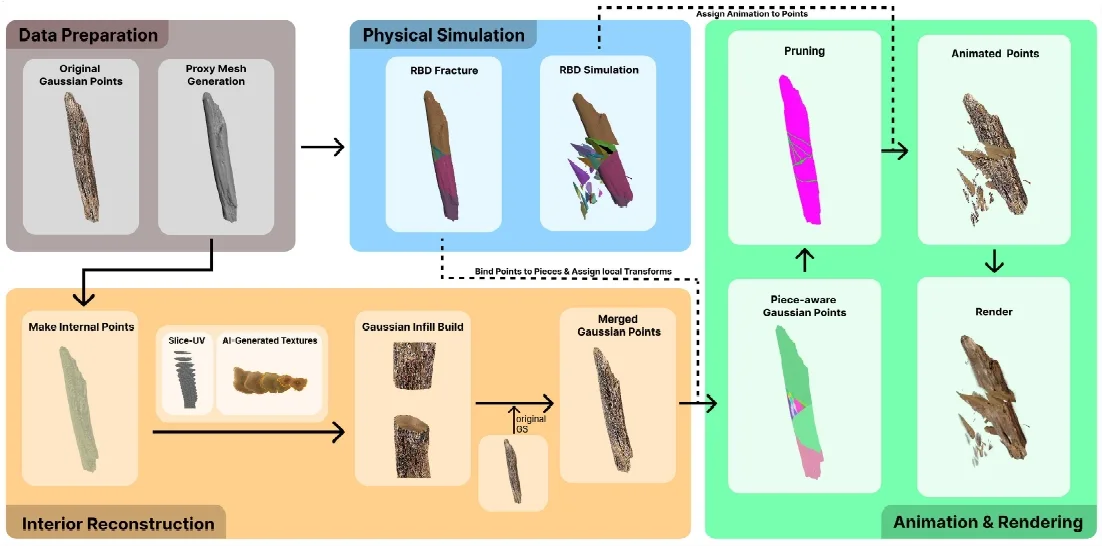
This paper presents an integrated pipeline that combines interior augmentation with piecewise rigid fracture simulation to address the hollow cross-section problem in 3D Gaussian splatting, where surface-centered representations often reveal empty interiors after fracture. The proposed method generates auxiliary interior Gaussian points using a signed distance field and reconstructs plausible internal appearances for exposed cut surfaces using slice-based coordinates and neighboring Gaussians. A proxy mesh reconstructed from the Gaussian distribution is used for fracture simulation, and the resulting piecewise transformations are transferred back to the Gaussian primitives through rest-frame binding. In addition, cut-aware pruning retains only the interior Gaussians required for cut-surface representation, thereby reducing computational cost. Experimental results demonstrate improved fracture continuity while achieving a practical balance between cut-surface quality and computational efficiency.
본 연구에서는 3D Gaussian Splatting(3DGS) 장면이 표면 중심 표현에 머물러 파괴 시 내부 단면이 비어 보이는 문제를 완화하기 위해, 내부 보강과 조각 기반 강체 파괴 시뮬레이션을 결합한 통합 파이프라인을 제안한다. 제안 방법은 signed distance field(SDF)를 기반으로 객체 내부에 보강용 가우시안 포인트를 생성하고, 슬라이스 기반 좌표와 주변 원본 가우시안 정보를 활용하여 절단면 노출 시 사용될 시각적 내부 표현을 구성한다. 이후 가우시안 분포로부터 복원한 프록시 메시에 조각기반 강체 파괴 시뮬레이션을 적용하고, 계산된 조각별 변형을 기준 프레임 바인딩을 통해 가우시안 프리미티브에 전달한다. 또한 절단면 기반 가지치기를 적용하여 절단면 표현에 필요한 내부 가우시안만 유지함으로써 계산 비용을 제어한다. 실험 결과, 제안 방법은 파괴 후 내부 공백을 완화하고 파괴 시퀀스의 공간적·시간적 일관성을 향상시키며, 절단면 품질과 계산 효율 사이의 균형을 제공함을 확인하였다.
Kyung-Joong Kim and Tae-Kyung Yoo. (2026). Position-Based Dynamics-Integrated Pipeline for Deformation and Visualization of 3D Gaussian Splatting. 디지털콘텐츠학회논문지, 27(1), 207-214.3차원 가우시안 스플레팅의 동적 변형 및 시각화를 위한 PBD 통합 파이프라인 연구포인트 클라우드가우시안 스플레팅위치 기반 다이나믹스물리 기반 시뮬레이션파이프라인Point CloudGaussian SplattingPosition-Based DynamicsPhysics-Based SimulationPipeline
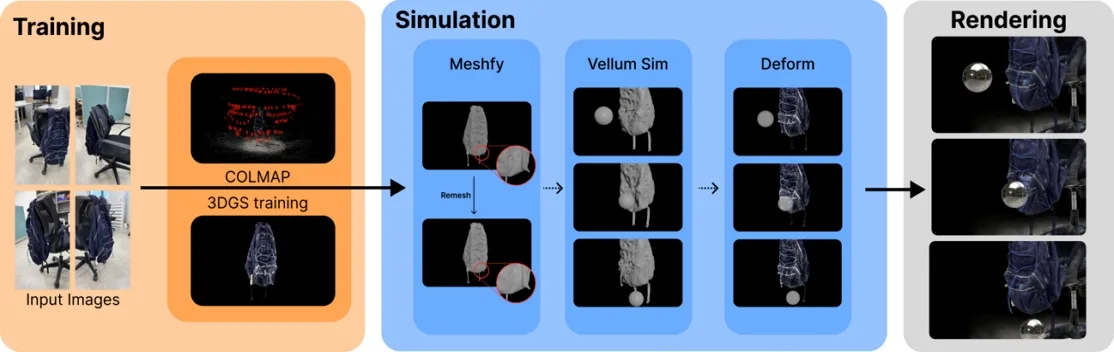
This study proposes a pipeline that can be used to dynamically create deformable virtual objects using point cloud data based on 3D Gaussian splatting (3D GS). Existing 3D GS research primarily focuses on high-speed rendering and static reconstruction, offering limited support for the physical deformation and interactive behaviors encountered in practical content production. To address this limitation, we integrated a Gaussian-based rendering structure with position-based dynamics (PBD) to enable the stable deformation of high-resolution point clouds. The proposed pipeline generates a low-resolution proxy mesh from the original 3D GS points, applies Vellum-based soft-body simulation, and transfers the resulting deformation back to the full-resolution Gaussian set via a point deform process, thereby enhancing production efficiency and expanding the applicability of Gaussian-based scene creation and interactive visualization.
본 연구는 3D Gaussian Splatting(3D GS) 기반 포인트 클라우드 데이터를 활용, 동적 변형이 가능한 가상 객체의 효율적 제작을 위한 파이프라인을 제안한다. 3D GS 관련 기존 연구들은 고속 렌더링과 정적 재구성에 주안점을 두어 실제 제작 과정에서 요구되는 물리적 변형이나 상호작용 표현에는 한계가 있었다. 이에 본 연구에서는 가우시안 기반 렌더링 구조와 함께 위치 기반 다이나믹스(PBD)를 결합하여 고해상도 점군에서도 안정적인 변형을 구현하고자 하였다. 연구에서 제안하는 파이프라인은 원본 3D GS 포인트로부터 저해상도 프록시 메쉬를 생성하고, 해당 메쉬에 Vellum 기반 연성 시뮬레이션을 적용한 뒤, 결과 변형을 Point Deform 과정을 통해 전체 해상도의 가우시안 세트로 전달한다. 이러한 접근 방법은 제작의 효율성을 높이는 것은 물론, 유연하고 직관적인 형태 변형이 가능해짐에 따라 GS 기반 장면 제작과 인터랙티브 시각화 활용 범위의 확장 가능성 제고에 기여한다.
Seung-Woo Jeong and Tae-Kyung Yoo. (2025). Gaussian Splatting Based Pipeline for High-Fidelity 3D Tree Asset Generation. 한국컴퓨터게임학회논문지, 38(7), 1-15.가우시안 스플래팅 기반 고정밀 3D 수목 에셋 생성 파이프라인Gaussian SplattingProcedural GenerationDigital TwinTree ModelingHybrid Pipeline
Recent advances in 3D data-driven digital twin research have revealed limitations in existing tree reconstruction methods, which rely solely on either scanning or procedural generation. To address this issue, this study proposes a hybrid pipeline that integrates data-driven reconstruction and procedural generation using Gaussian Splatting(GS) data. The proposed method converts multi-view GS outputs into dense point clouds and extracts a stable skeletal structure through color-density-based graph analysis. Fine branches and leaves are procedurally generated using a space colonization algorithm that incorporates botanical principles, achieving a natural and structurally coherent form. Quantitative evaluations using Chamfer distance and Intersection-over-Union metrics demonstrate high geometric similarity and volumetric consistency with the original GS data. The proposed GS-based hybrid framework ensures both visual realism and biological plausibility, enabling efficient and reliable digital twin tree modeling.
Eunsu Ji and Tae-Kyung Yoo. (2025). LLM-Based Story Generation Aligned with Narrative Structure. 한국컴퓨터게임학회논문지, 38(3), 61-72.서사 구조를 따르는 LLM 기반 스토리 생성 연구대형 언어 모델스토리 생성내러티브 구조프롬프트 체이닝계층적 스토리 생성Large Language ModelsStory GenerationNarrative StructurePrompt ChainingHierarchical Story Generation
This study proposes a structured story generation system based on traditional narrative theory using a large language model (LLM). The proposed system sequentially constructs a three-act structure and a 15-step narrative structure of "Save the Cat!" based on the log line, character information, and genre input by the user, and each step is embodied through hierarchical generation and prompt chaining. In particular, when user modifications occur, the changes are designed to be automatically reflected in the upper and lower stages to maintain narrative consistency and logic. To verify the effectiveness of this system, human-written narratives, single-prompt-based generative narratives, and generative narratives from the proposed system were compared and evaluated, yielding excellent results in terms of narrative structure fidelity and logic. By demonstrating the structural controllability of LLM-based story generation, this study suggests applicability in the field of digital content production in the future.
본 연구는 대형 언어 모델(LLM)을 활용하여 전통 서사 이론에 기반한 구조화된 스토리 생성 시스템을 제안한다. 제안된 시스템은 사용자가 입력한 로그라인, 캐릭터 정보, 장르를 바탕으로 3막 구조와 「세이브 더 캣!」의 15단계 내러티브 구조를 순차적으로 구성하며, 각 단계는 계층적 생성(hierarchical generation)과 프롬프트 체이닝(prompt chaining)을 통해 구체화된다. 특히 사용자가 내용을 수정할 경우, 해당 변경사항이 상위 및 하위 단계에 자동으로 반영되도록 설계되어 서사의 일관성과 논리를 유지할 수 있도록 하였다. 본 시스템의 효과성을 검증하기 위해 사람에 의해 작성된 내러티브, 단일 프롬프트 기반 생성 내러티브, 그리고 본 시스템을 통해 생성된 내러티브를 비교·평가한 결과, 내러티브 구조의 충실성과 논리성 측면에서 우수한 성과를 보였다. 본 연구는 LLM 기반 스토리 생성의 구조적 제어 가능성을 입증함으로써, 향후 디지털 콘텐츠 제작 분야에서의 활용 가능성을 제시한다.
Jong-Dae Choi and Tae-Kyung Yoo. (2025). Representing Camera Parallax Using Gaussian Splatting in Digital Background Compositing. 디지털콘텐츠학회논문지, 26(1), 103-112.디지털 배경 합성에서 가우시안 스플래팅을 활용한 카메라 시차 표현 방법 연구시각 효과디지털 합성3차원 재구성래디언스 필드가우시안 스플래팅Visual EffectsDigital Compositing3D ReconstructionRadiance FieldGaussian Splatting
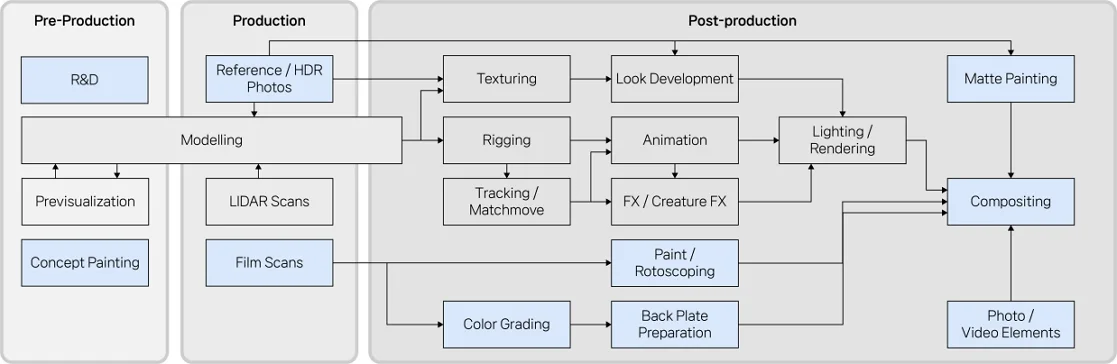
This study proposes a method to represent the parallax effect of cameras in digital background compositing using 3D models generated through "Gaussian Splatting," a 3D reconstruction technique introduced at SIGGRAPH 2023. To achieve this, 3D background assets were created from drone footage, and a technique for adjusting camera focus based on depth information was introduced. The study successfully implemented a parallax effect, which is challenging to achieve with conventional 2D compositing methods, demonstrating the feasibility of high-quality, reality-based 3D background compositing. By showcasing the potential of digital compositing through Gaussian Splatting, this research aims to improve work efficiency in the VFX industry, including real-time background compositing, camera parallax effect implementation using LED walls in virtual studios, and the development of libraries for Gaussian Splatting 3D assets.
본 연구는 ‘SIGGRAPH 2023’에서 발표된 3D 재구성 기술인 ‘가우시안 스플래팅’ 과정에서 생성된 3D 모델을 활용하여 디지털 배경 합성에서의 카메라 시차 효과 표현 방법을 제안한다. 이에, 드론 촬영 데이터를 기반으로 3D 배경 에셋을 생성하고, 깊이 정보를 활용한 카메라 초점 조절 방법을 제시하였다. 결과적으로 기존의 2D 합성 방식으로는 표현하기 어려웠던 카메라 시차 효과를 구현하여, 현실 기반 고품질 3D 배경 합성이 가능함을 확인했다. 본 연구는 가우시안 스플래팅을 통한 디지털 합성의 가능성을 제시함으로써 향후, 버추얼 스튜디오의 LED Wall를 활용한 실시간 배경 합성 및 카메라 시차 효과 구현, 가우시안 스플래팅 3D 에셋의 라이브러리화 등 VFX 산업 전반에 걸쳐 작업 효율성을 높이는 데 기여할 것이다.
Jisu Lee and Tae-Kyung Yoo. (2024). Real-Time Experience Management for LBXR: A Node-Based XR Operation System. 한국컴퓨터게임학회논문지, 37(4), 32-39.LBXRoperation systemmanagement toolnode-based interfacereal-timeexperience flow
In LBXR, experiences unfold based on user behavior and environmental context. To maintain and design immersive experiences in these environments, tools are needed to track and adapt user reactions in real-time. This research proposes an XR operation system that visualizes the player's experience flow in a node-based interface, enabling operators to intuitively grasp the full context of the content and control it in real-time. The proposed system overcomes the limitations of existing XR operation tools that rely on fragmented information and provide only fragmented interactions, and enables integrated content management based on real-time data. This research will inform the design of future XR operational tools.
Jungmin Lee and Tae-Kyung Yoo. (2024). Designing Asymmetric XR Multi-User Experience through Virtual-Physical Bidirectional Interaction. 한국컴퓨터게임학회논문지, 37(4), 19-29.virtual-physical bidirectional interactionasymmetric experiencestorytellingimmersionvirtual realitytangible interface
This paper proposes a Virtual-Physical bidirectional interaction system for connecting virtual user and physical user in an asymmetric XR environment. The proposed system is developed to implement the asymmetric XR experience <Treasure Hunter>, designed based on key storytelling elements for asymmetric environment, aiming to enhance the immersion and presence of both users. Unlike previous studies focusing on interaction in co-located environments or collaboration in industrial settings, this research distinctively integrates narrative and technical elements in asymmetric remote environments. It is expected to contribute to the design of future XR content and the development of integrated online-offline user experiences.
Hye-Min Yang and Tae-Kyung Yoo. (2023). Development of a Real-Time Quadruped Animal Character Rig System. 디지털콘텐츠학회논문지, 24(12), 2971-2980.실시간 사족보행 동물 캐릭터 리그 시스템 개발사족보행 동물캐릭터 리그 시스템절차적 리깅실시간성인공지능Quadruped AnimalCharacter Rig SystemProcedural RiggingReal-timeArtificial Intelligence
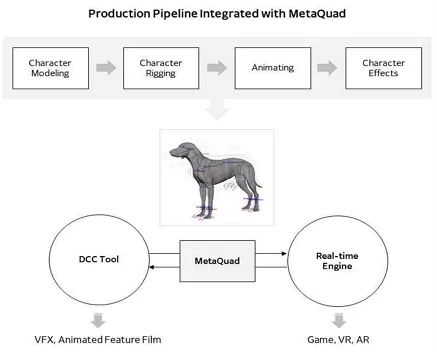
This paper proposes a real-time character rig system for efficiently utilizing quadruped animal characters in various immersive content types, including film, animation, games, virtual reality (VR), and augmented reality (AR). The proposed system effectively integrates the film production and real-time content creation pipelines. This approach mirrors the concept of “MetaHuman,” combining the production process of quadruped animal characters into a unified workflow and facilitating data sharing. We developed a program executable in Maya, which automatically generates a character rig system when a user inputs a model. This study provides a quadruped animal production guide aligned with industry trends and is expected to make a substantial contribution to various aspects of content creation, including planning, direction, and technical development of immersive content featuring animal characters.
본 연구는 영화, 애니메이션뿐만 아니라 게임, 가상현실(VR), 증강현실(AR) 등 다양한 실감형 콘텐츠에서 사족보행 동물 캐릭터를 효율적으로 활용하기 위한 실시간 캐릭터 리그를 제안한다. 본 연구에서 제안하는 시스템은 영화 제작 파이프라인과 실시간 콘텐츠 제작 파이프라인을 효과적으로 통합하는 접근 방식을 취한다. 이는 ‘메타휴먼’이 가진 개념과 동일하며, 사족보행 동물 캐릭터의 제작과정을 하나로 결합하고 데이터를 공유하는 형태로 구현했다. 본 연구는 산업 동향에 맞춘 사족보행 동물 제작 가이드를 제공함으로써, 동물 캐릭터를 포함한 실감형 콘텐츠의 기획, 연출 및 기술 개발 등 콘텐츠 제작의 다양한 분야에 실질적으로 기여할 것으로 기대된다.
Jungho Kim and Tae-Kyung Yoo. (2023). A Study on the Digital Twin Pipeline for Facial Digitizing System Optimization. 방송공학회논문지, 28(5), 530-544.3D 얼굴 외형 디지타이징 시스템 최적화를 위한 디지털 트윈 파이프라인 연구Digital twinDigital HumanFacial captureDigitizing SystemPipeline R&D
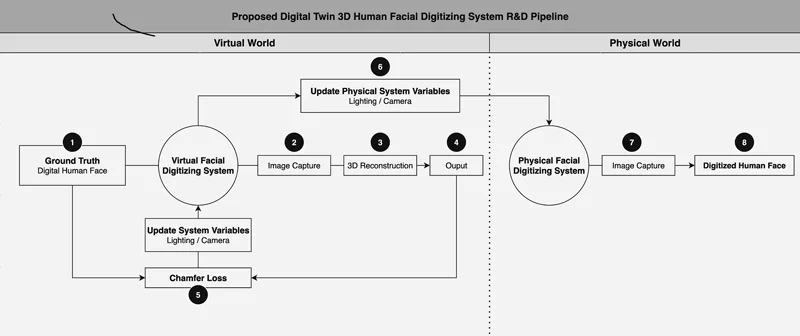
With digital humans being used extensively in blockbuster movies, triple-A games, and the entertainment industry, the demand for digital humans is growing exponentially. In response, VFX studios are continuously expanding their research into 3D facial appearance digitization pipelines to generate realistic digital human facial appearances. However, existing 3D facial appearance digitization pipelines have limitations in terms of labor-intensive methods in R&D and system improvement through qualitative methods. Therefore, in this study, we propose a pipeline optimization of 3D face digitizing system through digital twins. The proposed pipeline predicts and solves problems in digitizing through extensive simulations in a virtual space that reflects the characteristics of the physical space with a digital twin and applies it to the physical space. It can solve the labor-intensive method, which is a limitation of the existing pipeline, through the interaction of physical and virtual space. In addition, by improving the system through quantitative evaluation of the facial appearance generated in the virtual space, the system can be optimized to generate better digital human facial appearance compared to the existing pipeline. The proposed digital twin pipeline can generate realistic facial appearance based on quantitative evaluation, and can be expected to reduce the cost of system construction. We believe that this research will contribute to the introduction and establishment of digital twin pipelines in the VFX industry.
디지털휴먼이 블록버스터 영화, 트리플A 게임, 엔터테인먼트 산업 등에서 광범위하게 활용됨에 따라 디지털휴먼 수요가 기하급수적으로 증가하고 있다. 이에 VFX 스튜디오는 3D 얼굴 외형 디지타이징 파이프라인 연구를 지속적으로 확대하고 있으며, 사실적인 디지털휴먼 얼굴 외형을 생성하려고 한다. 하지만 기존 3D 얼굴 외형 디지타이징 파이프라인은 R&D 과정에서 노동집약적 방식과 정성적 방법을 통한 시스템 개선이라는 한계점을 지니고 있다. 따라서 본 연구에서는 디지털 트윈을 통한 3D 얼굴 디지타이징 시스템 파이프라인 최적화를 제안한다. 제안된 파이프라인은 디지털 트윈으로 물리적공간 특성을 반영한 가상공간에서 방대한 시뮬레이션을 통해 디지타이징에서 발생하는 문제를 예측하고 해결하여 물리적공간에 적용한다. 이는 물리적공간과 가상공간의 상호작용을 통해 기존 파이프라인의 한계점인 노동집약적 방식을 해결할 수 있다. 또한 가상공간에서 생성된 얼굴 외형을 정량적 평가를 통해 시스템을 개선하여, 기존 파이프라인 대비 시스템을 최적화하여 더 나은 디지털휴먼 얼굴 외형을 생성할 수 있다. 제안된 디지털 트윈 파이프라인은 정량적 평가를 토대로 사실적인 얼굴 외형을 생성하고, 시스템 구성에 있어 비용 절감 효과를 기대할 수 있다. 또한 본 연구를 시작으로, VFX 산업에서 디지털 트윈 파이프라인 도입 및 정립에 기여할 것이라고 생각한다.
Hye-Min Yang and Tae-Kyung Yoo. (2023). Metaverse Production Pipeline Based on 3D Space Capture Technology. 디지털콘텐츠학회논문지, 24(5), 1071-1082.3D 공간캡처 기술 기반의 메타버스 제작 파이프라인 연구메타버스파이프라인3차원 재구성교차 편광 촬영기법MetaversePipeline3D ReconstructionCross Polarization Photography Technique
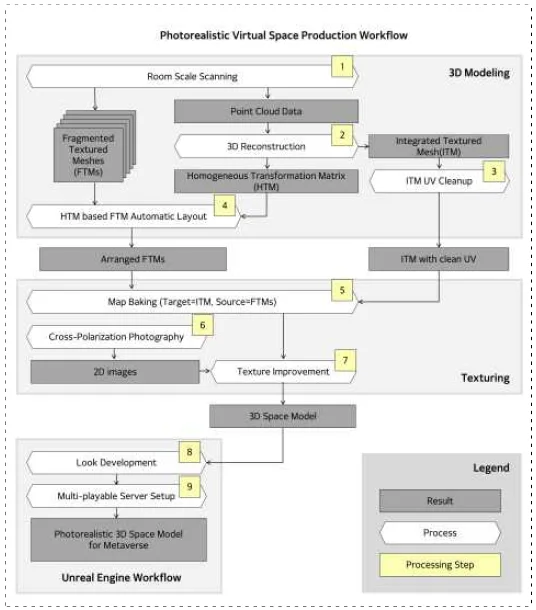
In this study, we proposed a production pipeline to effectively create virtual spaces for use in a highly immersive metaverse using 3D space capture technology. Previous research on virtual space production has focused primarily on the development of core technologies and the use of hardware. We aimed to combine and optimize the latest engineering technologies to make the production process commercially viable, and not merely focused on advancing them. We introduced automation using 3D reconstruction and cross-polarization photography technology based on existing asset creation and scene rendering techniques. The proposed method considers cost-effectiveness, that is, reducing the production time and costs, as well as productivity and software availability resulting from the automation of some of the work processes. In the future, the proposed pipeline will contribute to the infrastructure and technological development of the next-generation metaverse by enhancing the stability of virtual space production and supplementing technological capabilities.
본 연구는 3D 공간 캡처 기술을 이용하여 초 실감형 메타버스에 사용될 가상공간을 효과적으로 생산하기 위한 제작 파이프라인을 제안한다. 가상공간 제작과 관련한 기존의 연구는 핵심 요소 기술의 개발과 하드웨어 사용에만 초점을 맞춘 경우가 많았다. 우리는 고도화 차원에만 치우치지 않고 실제 생산과정에 상용화할 수 있도록 최신 공학 기술을 결합하고 최적화하고자 한다. 기존의 에셋 제작과 장면 렌더링 기법을 기반으로 3차원 재구성과 교차 편광 촬영기법을 도입하여 자동화한다. 제시된 방법은 생산 시간 및 비용 절감과 같은 비용 효율성뿐만 아니라 일부 작업공정의 자동화에 따른 생산성 및 소프트웨어 가용성을 고려한다. 향후 가상공간 생산의 안정성을 높이고 기술력을 보완하여 차세대 메타버스의 인프라와 기술발전에 기여할 것이다.
Jungho Kim, Hye-In Yoon, Jin-Wan Park, and Tae-Kyung Yoo. (2022). Barycenter Algorithm-based Silent Film Branch Detection: Focusing on Dziga Vertov's Man with a Movie Camera. 한국영상학회논문집 (콘텐츠 플러스), 20(5), 77-91.무게 중심 알고리즘(Barycenter Algorithm)을 활용한 무성 영화 분기 검출 - 지가 베르토프의 <카메라를 든 사나이>를 중심으로무게 중심영화 분기 검출장면 분석장면 분할BarycenterFilm Branch DetectionScene RecognitionScene Segmentation
등록된 정보가 없습니다.
Jungho Kim, Jin-Wan Park, and Tae-Kyung Yoo. (2022). A Study on Immersive Content Production and Storytelling Methods using Photogrammetry and Artificial Intelligence Technology. 방송공학회논문지, 27(5), 654-664.포토그래메트리 및 인공지능 기술을 활용한 실감 콘텐츠 제작과 스토리텔링 방법 연구Immersive ContentsPhotogrammetryArtificial IntelligeneVirtual BeingseXtented Reality
Immersive content overcomes spatial limitations through convergence with extended reality, artificial intelligence, and photogrammetry technology along with interest due to the COVID-19 pandemic, presenting a new paradigm in the content market such as entertainment, media, performances, and exhibitions. However, it can be seen that in order for realistic content to have sustained public interest, it is necessary to study storytelling method that can increase immersion in content rather than technological freshness. Therefore, in this study, we propose a immersive content storytelling method using artificial intelligence and photogrammetry technology. The proposed storytelling method is to create a content story through interaction between interactive virtual beings and participants. In this way, participation can increase content immersion. This study is expected to help content creators in the accelerating immersive content market with a storytelling methodology through virtual existence that utilizes artificial intelligence technology proposed to content creators to help in efficient content creation. In addition, I think that it will contribute to the establishment of a immersive content production pipeline using artificial intelligence and photogrammetry technology in content production.
실감 콘텐츠는 COVID-19 팬데믹으로 인한 관심과 더불어 확장현실, 인공지능, 포토그래메트리 기술과 융합을 통해 공간적 한계를 극복하며 엔터테인먼트, 미디어, 공연, 전시 등 콘텐츠 시장에서 새로운 패러다임을 제시하며 수요 역시 증가하고 있다. 하지만 실감 콘텐츠가 대중들에게 지속된 관심을 가지기 위해서는 기술적 신선함보다 콘텐츠에 대한 몰입도를 높일 수 있는 스토리텔링 방법 연구가 필요하다는 것을 알 수 있다. 따라서 본 연구에서는 인공지능 및 포토그래메트리 기술을 활용한 실감 콘텐츠 스토리텔링 방법을 제안한다. 제안된 스토리텔링 방법은 대화형 가상존재와 참여자가 대화를 통한 상호작용으로 콘텐츠 스토리를 생성하는 것이다. 이에 관객 주도적 참여를 통해 콘텐츠 몰입도를 높일 수 있다. 본 연구는 가속화되는 실감 콘텐츠 시장에서 콘텐츠 제작자들에게 제안된 인공지능 기술이 활용된 가상존재를 통한 스토리텔링 방법론으로 효율적인 콘텐츠 제작에 도움을 줄 수 있을 것으로 기대한다. 또한 콘텐츠 제작에 있어 인공지능 및 포토그래메트리 기술을 활용한 실감 콘텐츠 제작 파이프라인 정립에 기여할 것이라고 생각한다.
Jae-Seok Yoo, Tae-Kyung Yoo, and Sang-Hyun Seo. (2022). AI-Based 3D Spatial Structure Estimation Using Indoor Floor Point Clouds. 디지털콘텐츠학회논문지, 23(6), 1013-1020.실내 바닥면 포인트 클라우드를 이용한 AI 기반 3D 공간구조 추정 기술3D 재구성공간구조 추정디지털 트윈코너 탐지메타버스3D reconstructionSpatial Structure EstimationDigital TwinConer DetectionMetaverse
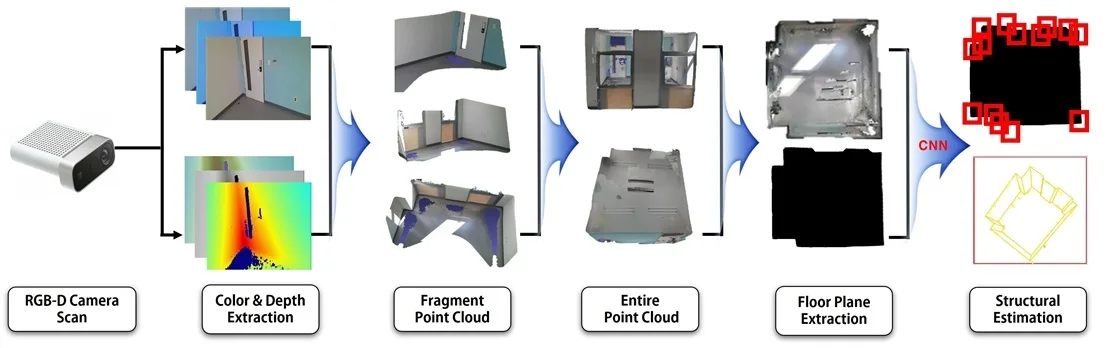
In this paper, we construct a virtual space composed of point clouds by scanning real-world indoor spaces using RGB-D cameras. Point clouds have distributed and noisy properties, making it difficult and a very challenging task to reconstruct a virtual space similar to the real world (using point clouds). We propose an efficient method for estimating and modeling the structure of 3D space based on CNN model. Based on the 3D reconstruction algorithm, an indoor point cloud is created through RGB-D images and floor data is extracted. Floor point cloud data is projected and converted into 2D binary images, and corners of floor is detected using CNN model. Based on this, the 3D spatial structure of the indoor space is estimated and modeled. In the future, this study will contribute to efficiently establishing a metaverse space similar to the real world.
본 논문에서는 RGB-D 카메라를 이용해 실세계 실내 공간을 스캔하여 포인트 클라우드로 구성된 가상공간을 구축한다. 포인트 클라우드는 분산되고 노이즈가 많은 특성이 있어 (포인트 클라우드를 이용하여) 실세계와 유사한 가상공간을 재구성하는 것은 어려운 일이며 매우 도전적인 과제이다. 우리는 CNN 모델을 기반으로 3차원 공간의 구조를 추정하여 모델링 하는 효율적인 방법을 제안한다. 3차원 재구성 알고리즘을 기반으로 RGB-D 이미지 통해 실내 포인트 클라우드를 생성하고, 바닥면 데이터를 추출한다. 바닥면 포인트 클라우드 데이터는 2차원 바이너리 영상으로 투영 변환되고, CNN 모델을 이용해 바닥면의 코너를 탐지한다. 이를 기반으로 실내 공간의 3차원 공간구조를 추정하고 모델링 한다. 향후 본 연구는 효율적으로 실세계와 유사한 메타버스 공간을 구축하는 데에 기여할 것이다.
Boa Rhee, Federico Pianzola, Nayea Oh, Gangta Choi, and Jungho Kim. (2021). Remediating tradition with technology: A case study of From Tangible to Intangible: A Media Showcase of Kisa chin p'yori chinch'an uigwe. Digital Creativity, 32(1), 56-70.gesture interactioninteractive mediaKorean manuscriptsound visualizationuser experience
This paper presents the remediation of a nineteenth century Korean manuscript (the 1809 Uigwe ) as an interactive digital experience using creative algorithms and gesture recognition developed by LG Electronics. The interactive media project we created using sound visualization invites visitors to jointly experience Joseon ’s royal music and the manuscript’s pictorial illustrations. We present the media development process and the results of a survey assessing users’ engagement. Our findings show that technological remediation can be a fruitful way to elicit interest for cultural heritage. The Uigwe media project enhanced the participants’ curiosity for the 1809 Uigwe , and the added sound of the traditional court music (Yeominlak ) and the images of the musical instruments increased users’ understanding of the 1809 Uigwe and of royal court music. Overall, the study provides evidence about the use of multisensory digital media for fostering learning about and cultural appreciation of historical artefacts.
Jungho Kim and Tae-Kyung Yoo. (2021). Correlation between Head Movement Data and Virtual Reality Content Immersion. 방송공학회논문지, 26(5), 500-507.헤드 무브먼트 데이터와 가상현실 콘텐츠 몰입도 상관관계Head Movement VelocityImmersiveVirtual AnimationStorytellingContent Evaluation
The virtual reality industry has an opportunity to take another leap forward with the surge in demand for non-face-to-face content and interest in the metaverse after Covid-19. Therefore, in order to popularize virtual reality content along with this trend, high-quality content production and storytelling research suitable for the characteristics of virtual reality should be continuously conducted. In order for content to which virtual reality characteristics are applied to be effectively produced through user feedback, a quantitative index that can evaluate the content is needed. In this study, the process of viewing virtual reality contents was analyzed and head movement was set as a quantitative indicator. Afterwards, the experimenter watched five animations and analyzed the correlation between recorded head movement information and immersion. As a result of the analysis, high immersion was shown when the head movement speed was relatively slow, and it was found that the head movement speed can be used significantly as an index indicating the degree of content immersion. The result derived in this way can be used as a quantitative indicator that can verify the validity of the storytelling method applied after the prototype is produced when the creator creates virtual reality content. This method can improve the quality of content by quickly identifying the problems of the proposed storytelling method and suggesting a better method. This study aims to contribute to the production of high-quality virtual reality content and the popularization of virtual reality content as a basic research to analyze immersion based on the quantitative indicator of head movement speed.
가상현실 산업은 Covid-19 이후 비대면 콘텐츠 수요 급증과 메타버스에 대한 관심과 더불어 재도약할 기회를 얻었다. 따라서 이러한 흐름과 함께 가상현실 콘텐츠를 대중화를 위해서는 양질의 콘텐츠 제작과 가상현실 특성에 맞는 스토리텔링 연구가 지속적으로 이루어져야 한다. 이처럼 가상현실 특성을 적용한 콘텐츠가 사용자 피드백을 통해 효과적으로 제작되기 위해서는 해당 콘텐츠를 평가할 수 있는 정량적 지표가 필요하다. 본 연구에서는 가상현실 콘텐츠를 관람하는 과정을 분석하여 머리 움직임을 정량적 지표로 설정하였다. 이후 실험자는 5개 애니메이션을 관람하고 이에 따라 기록된 머리 움직임 정보와 몰입도 간의 상관관계를 분석하였다. 분석 결과는 머리 움직임 속도가 상대적으로 느릴 때 높은 몰입도를 나타내었고, 머리 움직임 속도가 콘텐츠 몰입도 정도를 나타내는 지표로 유의미하게 사용될 수 있다는 것을 알 수 있었다. 이렇게 도출된 결과는 이후 창작자가 가상현실 콘텐츠 제작을 할 때 프로토타입 제작 후 적용된 스토리텔링 방식의 유효성을 검증할 수 있는 정량적 지표로 사용될 수 있다. 이러한 방식은 제안된 스토리텔링 방식 문제점을 빠르게 파악하고 더 나은 방식을 제안할 수 있어 콘텐츠의 질을 향상시킨다. 본 연구는 머리 움직임 속도라는 정량적 지표를 기반으로 몰입도를 분석하는 기초연구로 양질의 가상현실 콘텐츠 제작과 가상현실 콘텐츠 대중화에 기여하고자 한다.
Boa Rhee, Ye-Eun Seo, and Tae-Kyung Yoo. (2021). The Barycenter Pattern Analysis of Claude Monet's Artworks from the Convergent Perspective: Focusing on Series of Wheatstacks, Rouen Cathedral and Water Lilies. 한국과학예술융합학회, 39(4), 399-411.융합적 관점에서 접근한 클로드 모네 작품의 하위 무게 중심 유형 분석 - 건초더미 연작, 루앙대성당 연작, 수련 연작을 중심으로 -Barycenter Pattern Analysis(무게 중심 유형 분석)Distribution of brightness and saturation(명도와 채도의 분포)Visualization(시각화)Series of Claude Monet(모네의 연작)Convergent research(융합연구)
This study starts with the possibility of a quantitative analysis of artworks through the convergent of art history and technology. The purpose of this study is to computationally analyze the distribution of brightness and saturation of Monet’s series through the Barycenter Pattern Analysis and to visualize the data. The results are as follows: In the three series, the positions of center point and the distribution of Barycenter Pattern of brightness and saturation differ depending upon the production time and season of the artworks (i.e. the change of light). In the case of ‘Wheatstacks,’ the distributions of brightness are affected by the arrangement of the subject, and the influences of light and weather on the distribution of the central point of brightness and saturation are presented in a certain pattern in the series of ‘Rouen Cathedral.’ In particular, in the case of ‘Water Liles’ series, several irregular patterns are revealed in the distribution of the Barycenter of brightness and saturation due to the the worsening of cataract problems. For example, the distribution of brightness and saturation in the artworks which were produced before the diagnosis of cataract reveals a certain pattern. On the other hands, the distribution of brightness or saturation in the artworks which were produced after the diagnosis of cataract becomes more irregular. The significance of this study is to prove the possibility of discovering the painter’s style change or the painter’s personal influence, which cannot be discovered by a qualitative method, through the Barycenter Pattern Analysis. As various technological approaches are converged with art research methodologies, we expect that the applications of quantitative methodologies can be expanded to illuminate the relevance between works of art and to identify art forgeries.
본 연구는 미술사와 공학이 융합된 정량적 예술작품분석에 대한 가능성으로부터 시작되었다. 본 연구의 목적은 하위 무게 중심 유형 분석(Barycenter Pattern Analysis)을 통해 정량적으로 모네의 연작에 대한 분석을 실행하고, 그 데이터를 시각화하는데 있다. 연구 결과 및 내용은 다음과 같다: 세 가지의 연작에서 작품의 제작 시간과 계절, 즉 빛의 변화에 따라 명도와 채도의 중심점 위치와 분포가 상이하게 나타났다. 건초더미의 경우, 대상의 배치에 따라 명도의 분포가 달라졌으며, ‘루앙대성당’의 경우에는 명도와 채도의 중심점 분포 변화에 대한 빛과 날씨의 영향력이 입증되었다. 특히 ‘수련’의 경우에는 명도와 채도의 분포에서 백내장으로 인한 시력의 영향력이 드러났다. 예를 들면, 백내장을 진단받기 전의 작품에서는 명도와 채도의 분포가 일정한 양식을 보였다. 반면, 진단을 받은 이후에는 명도나 채도의 분포가 더욱 응집되거나 더욱 산개되는 불규칙한 특징 나타났다. 본 연구는 정성적인 방법으로는 발견되지 못했던 화가의 양식 변화나 화가의 개인적 영향력 등을 명도와 채도의 무게 중심 유형 분석을 통해 발견할 수 있다는 가능성을 입증해 주었다는데 그 의의를 둘 수 있다. 다양한 공학적 접근이 미술사 연구방법론과 융합되면서, 향후 정량적 연구방법론은 예술작품간 관계성 및 위작 판별 등으로 그 응용이 확대될 것으로 전망된다.
Tae-Kyung Yoo. (2021). Film Production Using Artificial Intelligence with a Focus on Visual Effects. 한국엔터테인먼트산업학회논문지, 15(1), 53-62.인공지능을 이용한 영화제작 : 시각효과를 중심으로Film ProductionVisual EffectsArtificial IntelligencePipelineMachine LearningDeep Learning영화제작시각효과인공지능파이프라인머신러닝딥러닝
After the first to present projected moving pictures to audiences, the film industry has been reshaping along with technological advancements. Through the full-scale introduction of visual effects-oriented post-production and digital technologies in the film-making process, the film industry has not only undergone significant changes in the production, but is also embracing the cutting edge technologies broadly and expanding the scope of industry. Not long after the change to digital cinema, the concept of artificial intelligence, first known at the Dartmouth summer research project in 1956, before the digitalization of film, is expected to bring about a big transformation in the film industry once again. Large volume of clear digital data from digital film-making makes easy to apply recent artificial intelligence technologies represented by machine learning and deep learning. The use of artificial intelligence techniques is prominent around major visual effects studios due to automate many laborious, time-consuming tasks currently performed by artists. This study aims to predict how artificial intelligence technology will change the film industry in the future through analysis of visual effects production cases using artificial intelligence technology as a production tool and to discuss the industrial potential of artificial intelligence as visual effects technology.
영화는 대중에게 처음 소개된 이래로 테크놀로지의 발전과 변화 과정을 함께하고 있다. 영화 제작 과정에 시각효과를 중심으로 한 포스트 프로덕션과 디지털 기술들이 본격적으로 적용되면서 영화 산업은 제작 방식에 있어서 큰 변화를 겪었을 뿐만 아니라 최신 기술들을 폭넓게 수용하며 산업적 기회의 폭을 넓혀가고 있다. 디지털 영화로 변화한 지 오래지 않은 지금, 영화의 디지털화가 시작되기도 전인 1956년 다트머스 회의에서 처음 알려진 인공지능이란 개념이 다시 영화 산업의 큰 변화를 가져올 것으로 예상된다. 디지털 영화의 제작 파이프라인은 거대한 디지털 데이터를 체계적으로 운용하고 만들어 내기 때문에 머신러닝과 딥러닝으로 대표되는 최근 인공지능기술들을 적용하기 용이하고 시각효과 제작 과정에는 반복적인 작업과 분석을 통한 재현이 많고 계산시간이 오래 걸리는 과정들이 있기 때문에 최근 주요 시각효과 스튜디오들을 중심으로 인공지능 기술의 활용이 두드러지고 있다. 본 연구에서는 제작 도구로서 인공지능 기술을 이용한 영화 시각효과 제작 사례에 대한 분석을 통해서 향후 인공지능 기술이 영화 산업을 어떻게 바꿔놓을지 예측하고 시각효과기술로서 인공지능의 산업적 가능성을 조망해 보고자 한다.
Jung-Ho Kim and Jin-Wan Park. (2020). A Study on the StoryBoard for Preproduction in VR Platform. Journal of Digital Contents Society, 21(4), 663-672.가상현실 플랫폼에서 프리프로덕션을 위한 스토리보드 연구VR StoryboardPreproductionVR content Directing Method
As hardware and software advancements in VR field increase, demand for VR negative contents is gradually increasing, and demands for highly finished contents. However, VR platforms have different characteristics from ordinary video platforms, which limits the application of existing video grammar and story boards that were previously used for producing images. In this study, we developed storyboard production tools, including painting and editing functions with VR platform characteristics, by releasing improvement directions through case studies on storyboard production tools that were previously used, and expanding them from 2D to 360° space. Storyboard production tools that are tailored to VR platform characteristics allow for detailed production during preproduction phase. Therefore, in this study, we expect that this writing tool will help produce highly mature content as it shares the process as a communication tool when producing animatics.
Young-Ho Kim, Jungho Kim, and Jin-Wan Park. (2020). A Study Out of Register Expression Methods in a Real-Time Rendering Environment. Journal of Korean Society of Media and Arts, 18(4), 21-32.실시간 렌더링 환경에서의 Out of Register 표현법 연구NPRout of registerrealtimerenderingmedia
In this study, we develop a non-photorealistic rendering expression technique that can be used in a real-time rendering environment based on the out-of-register concept, which is a type of accidental printing error. First, to develop the expression technique, out-of-register causes and cases were analyzed. We considered why the out-of-register concept was developed as a graphic element. Second, each characteristic was analyzed by examining cases of non-photo-realistic rendering expressions. The implementation method was realized through a linear algorithm without the use of machine learning, which is one of many methods. It is implemented through a linear algorithm for constant and predictable result values. Furthermore, we utilized algorithms and interfaces for effective expressions. We constructed and applied simple 3D cube shapes, characters, and virtual environments in a real-time rendering environment using the implemented expression method. Given that various forms of media are being produced in a real-time environment through expression methods, it is expected that this paper will help with the expression of the essential parts of things and applications of expression techniques when creating content.
Jungho Kim, Jin-Wan Park, and Tae-Kyung Yoo. (2020). Analysis of Two-Way Communication Virtual Being Technology and Characteristics in the Content Industry. 방송공학회논문지, 25(4), 507-517.콘텐츠 산업에서 나타난 양방향 소통 가상존재 기술 및 특성 분석Virtual BeingInteractivityPersonalityAutonomous AnimationTwo-way Communication
Along with the development of computer graphics, real-time rendering, motion capture, and artificial intelligence technology, virtual being that enables two-way communication has emerged in the content industry. Although the commercialization of technologies and platforms is creating a two-way communication virtual being, there is a lack of analysis of what characteristics this virtual being has and how it can be used in each field. Therefore, through technical background survey and case study for the production of virtual being, the two-way communication virtual being is analyzed on the characteristics necessary for emotional exchange. The characteristics needed for emotional exchange were divided into interaction, individuality, and autonomy, and this characteristic is classified as the focus and how two-way communication virtual being will be used in the content field. This study is expected to provide significant implications for the research of content production and utilization using virtual being as a basic study of virtual being, which analyzes the technical background and characteristics for two-way communication required for virtual being production.
컴퓨터 그래픽스, 실시간 렌더링, 모션 캡처, 인공지능 기술의 발전과 함께 양방향 소통이 가능한 가상존재가 콘텐츠 산업에 등장하였다. 기술 및 플랫폼의 상용화로 인해 양방향 소통 가상존재가 제작되고 있지만, 가상존재들이 어떤 특성이 있으며 각 분야에서 어떻게 활용될 수 있을 것인지에 대한 분석이 부족하다. 이에 본 연구에서는 가상존재 제작을 위한 기술적 배경조사와 사례연구를 통해 양방향 소통 가상존재가 감정 교류에 필요한 특성에 대해 분석한다. 감정 교류에 필요한 특성은 상호작용, 개성, 자율성으로 나누어졌으며, 이 특성들을 중심으로 가상존재를 분류하며 양방향 소통 가상존재가 콘텐츠 분야에서 어떻게 활용될 것인지에 대해 고찰한다. 본 연구는 가상존재 제작에 필요한 기술적 배경 조사와 가상존재가 양방향 소통에 필요한 특성을 분석하는 기초연구로써 앞으로 가상존재를 활용한 콘텐츠 제작 및 활용 연구에 있어 유의미한 시사점을 제공할 것이라고 기대한다.
Jung-Ho Kim, Jae-Kyoung Kim, and Boa Rhee. (2019). A Study on VR Animation Directing: Focused on VR Animation DreamTherapy. Journal of Digital Contents Society, 20(9), 1789-1798.VR 애니메이션 연출법 연구 - VR 애니메이션 DreamTherapy를 중심으로VR AnimationGame ElementInteractionImmersionDirecting of Animation
In the case of games and animations in the entertainment industry, the importance of directing has been emphasized because the sense of immersion of audience in storytelling depends on the directing methods. Due to the nature of VR contents, however, the directing methods used in existing animations and games are bound to be used in a limited way. In this study, ‘DreamTherapy’, a VR animation, was produced by combining gaming and interaction elements to enhance immersion and efficient storytelling of VR contents. To sum up, these elements successfully convey the sense of accomplishment and immersion to the audience, but also allow storytelling to be faithful to the director’s intention. From practical and academic perspective, we hope that this study provides significant implications for immersion of storytelling methods of animation used in VR space.
Tae-Kyung Yoo. (2018). Study on Storytelling of VR Cartoons. 방송공학회논문지, 23(1), 45-52.VR 카툰의 스토리텔링 연구VRWebtoonStorytellingVR CartoonsPresence
The virtual reality (VR) cartoon is a format of VR contents that leverage the characteristics of webtoons that provides the simple story line and graphical storytelling tools to strategically surmount limitations of VR contents design. The VR cartoon enables people to experience the imaginary three-dimensional space in the webtoon as a real space by the transformation of webtoon contents through VR prototyping. The VR cartoon successfully presents focused environment where people can readily pay attention to the contents without notable motion sickness. People have been familiar with the storytelling strategy in the context of published cartoons and webtoons, likely we’ve understood the narrative of a movie through the continuous scenes projected in the screen. Indeed, it has been recognized as a popular toolset of communication, where visual images are sequentially delivered by replacing multiple planar spaces to tell a story narrative. While there are discrete panels with the time and space resolution in the graphical cartoons, people can distill a commit closure based on their past experiences. This is a typical "grammar" of the cartoon, which can be extrapolated to the VR cartoon that provides a seminal storytelling strategy. In this article, we review how the storytelling strategy in webtoons has been transformed into that in VR cartoons, and analyze the key components of VR cartoons. We envision that our research can potentially create keystones to produce variety of new VR contents by reflecting various narrative media including cartoon as a "sequential art".
VR 카툰은 웹툰의 간명한 스토리와 칸을 이용한 그래픽 스토리텔링을 VR 콘텐츠 디자인의 한계를 극복하는 전략으로 활용한 VR 콘텐츠 포맷이다. VR 프로토타이핑을 통해 웹툰 콘텐츠를 VR로 전환하여 웹툰 상의 3차원 공간에 실제 존재하는 듯 한 체험을 가능하게 하였다. 기존 VR 콘텐츠에 비해 어지럽지 않게 관람 가능하고 몰입이 잘 된다는 평균적인 피드백을 받을 수 있었다. 우리는 영화 스크린을 통해 스토리를 이해하는 데 익숙한 거처럼 그 동안의 출판 만화와 웹툰들을 통해 만화의 스토리텔링에 익숙해져 있다. 즉, 칸이라는 평면적 공간을 바꿔 가며 연속된 시각 이미지들을 통해 스토리를 전달하는 것은 우리에게는 보편화 된 커뮤니케이션 방법이다. 시간과 공간을 분할하는 만화의 칸 사이에는 아무것도 보이지 않는 홈통만이 존재하지만 우리는 경험에 의한 완결성 연상을 하게 된다. 바로 이러한 만화의 문법이 VR 카툰에서 차용하게 된 가장 핵심적인 스토리텔링 기법이다. 본고에서는 웹툰의 스토리텔링이 어떤 형태로 VR 카툰의 스토리텔링으로 전환 되었는지를 살펴보고 VR 카툰의 요소들을 분석해 본다. 이 연구를 통해 무한한 가능성을 가진 ‘연속 예술’, 만화를 비롯한 다양한 서사 매체들의 특성을 VR 콘텐츠 제작에 접목하는 시도의 기반 연구로서 역할을 할 수 있기를 기대한다.